
Self-Care for Carers
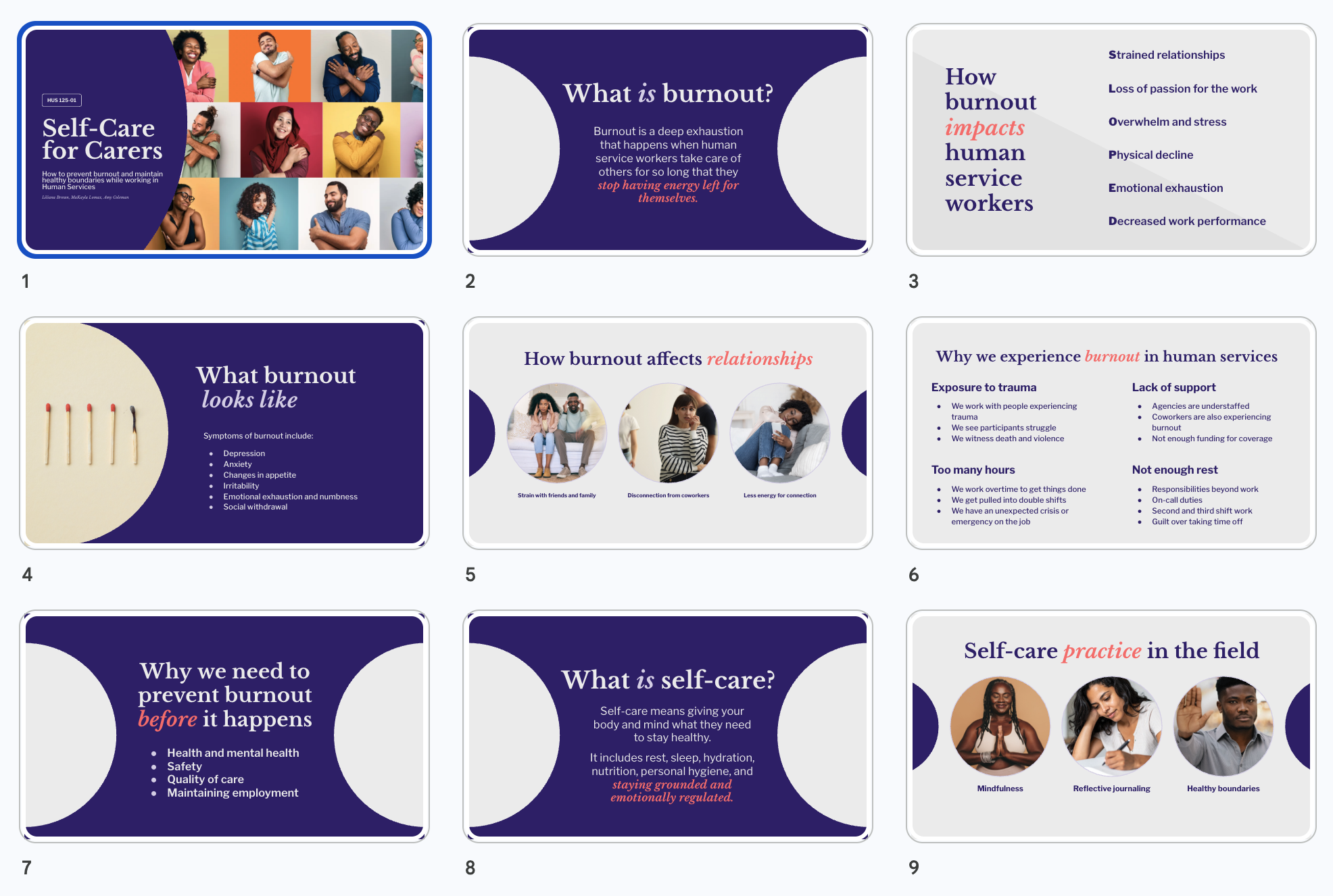
How to prevent burnout and maintain healthy boundaries while working in Human ServicesA group facilitation project for HUS 125-01. Groups were asked to choose a topic in human services and create a presentation and pamphlet informing the rest of the class about that topic. We chose an ambitious topic: burnout and self-care in the field.

The presentation
We created a 20-slide presentation including a title slide and QR code slide. Each of us had six slides to explain our section of the presentation. This worked out to about 8 minutes of speaking time per group member. We made a PDF of the Google Slides document available for download in case anyone wanted to refer to it later. The end of our presentation included a set of links to self-care practices and guides from solid sources.
There was a maintenance issue the day of our presentation that closed down campus, so we didn’t get a chance to present to our classmates. We each recorded video instead and submitted it as one training video presentation for grading.
The pamphlet
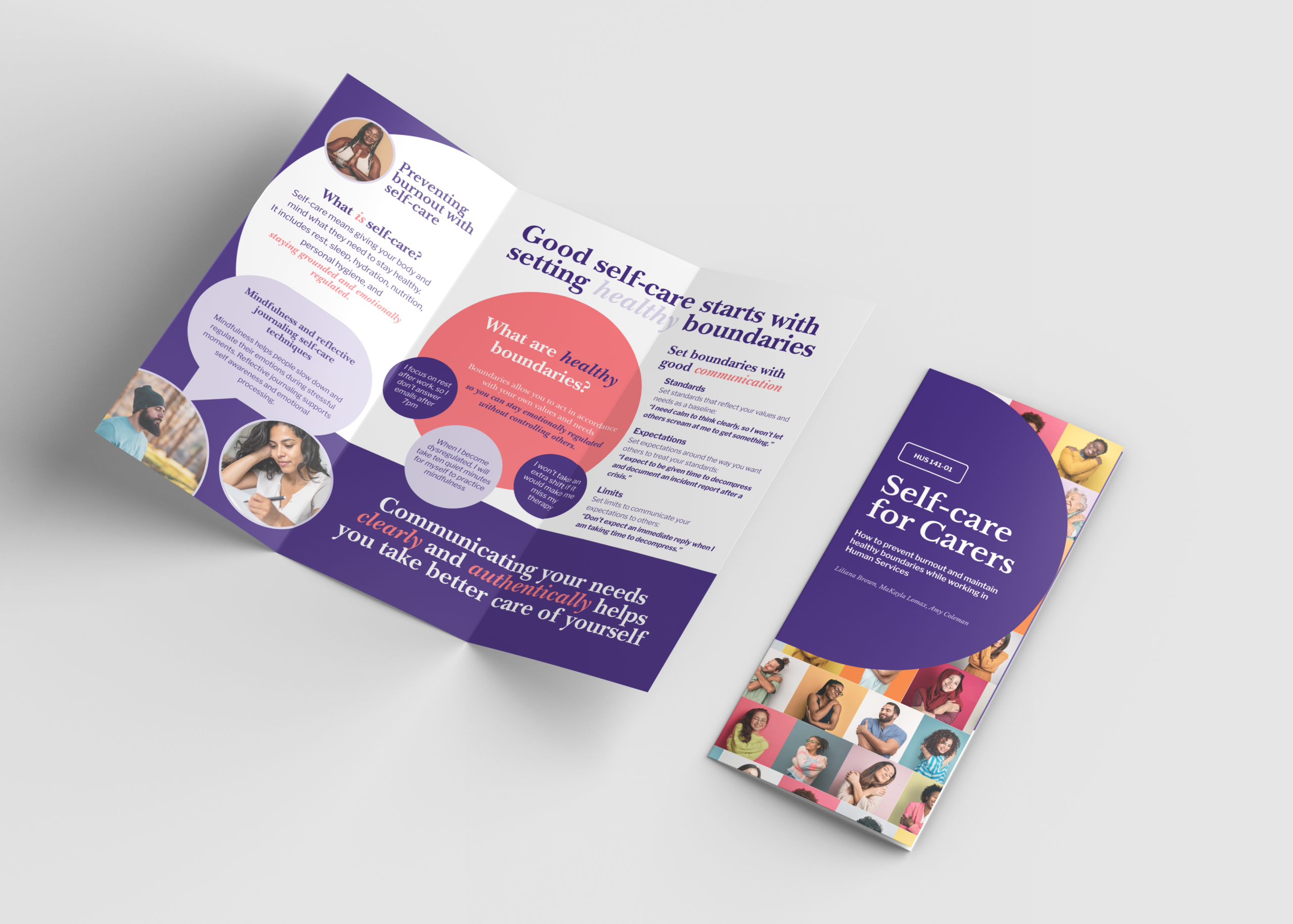
We created a tri-fold brochure that covered the most important parts of our presentation and included extra resources. I had about 20 copies printed, folded, and brought to class to pass out at the end of the presentation.
Because of all the other work I was doing this semester, I got a little lazy and made the brochure in Canva using stock images from AdobeStock and my Canva PRO subscriptions. The pamphlet was the least important component of our grade, but I still wanted it to be something we could share and show off.
About the assignment
We completed this project for HUS 125-01: Group Facilitation, a course that teaches students how to effectively counsel and work in groups as human service workers. For our assignment, Prof. Tony Yeulenski had us divide into groups and select a topic relevant to human services to present to our fellow classmates and create a pamphlet. We were also tasked with evaluating our peers and writing a five page final reflection paper about the project.
In my group, MaKayla suggested the topic of self-care, and we unanimously supported it. We also added burnout, boundaries, and power dynamics as relevant subtopics.
Group roles and dynamics
Our group elected to meet online every Sunday and primarily communicate via text. We each took one-third of the content: burnout, self-care, and boundaries / power dynamics. Truthfully, each of these could have been one huge topic in and of themselves, but we had a rough plan to tie it all together and make it work. The idea we wanted to impart was not a thorough overview of self-care, but to motivate our fellow students to take it seriously.
Some of our classmates have already been working in the field and know the feeling of burnout from experience. We didn’t need to overexplain it. We wanted to give them permission to take care of themselves and set appropriate boundaries for work-life balance.
Each of us did independent research on our section to bring back to the group. We organized everything in a shared Google Drive folder. Then I had my group members give me an outline of their section and helped them organize everything into six clear, uncluttered slides.
Since my fellow group members weren’t as confident with public speaking from an outline or off the top of their head, I also helped them develop speaker notes that they could read from while they presented their section. I created the presentation and pamphlet documents and took a leadership role so that I could keep everyone on track over the course of the assignment.
To make our presentation extra helpful and encourage our classmates to learn more, I created a webpage containing additional links and resources for self-care and boundary setting.
The final reflection paper
At the conclusion of the project we needed to submit a final reflection paper that explored our group process through the concepts we learned in lecture.
References
Bloom, S. L. (2016). Creating sanctuary: Toward the evolution of sane societies (2nd ed.). Routledge.
Cole, R., Fantus, S., Hawkins, L., & Chakraborty, P. (2024). Professional self-care in social work practice: A new conceptual framework. Social Work, 70(1), 31–40. https://doi.org/10.1093/sw/swae049
Collins, C. R., Sauce, H., Wafer, A., & Guzman, E. (2025). Using reflective journaling in supervision as a means of promoting self-care practices. Social Work, 70(3), 225–233. https://doi.org/10.1093/sw/swaf019
Darling Downs Health. (2021, November 22). Signs you might be experiencing a burnout and how to regain balance in your life. https://www.darlingdowns.health.qld.gov.au/about-us/our-stories/feature-articles/signs-you-might-be-experiencing-a-burnout-and-how-to-regain-balance-in-your-life
Guidry, A. (2025, May 9). 5 signs you’re experiencing burnout—and why it’s not just “stress”. Legacy Community Health. https://www.legacycommunityhealth.org/newsblog-5-signs-youre-experiencing-burnout-and-why-its-not-just-stress/
Kaplan, D. B., Silverstone, B., Kolb, P., & Strong, P. (2025). Current issues in social work supervision. Social Work, 70(3), 189–194. https://doi.org/10.1093/sw/swaf017
Kim, H., Ji, J., & Kao, D. (2011). Burnout and physical health among social workers: A three-year longitudinal study. Social Work, 56(3), 258–268. https://doi.org/10.1093/sw/56.3.258
Lipsky, L. V. N., & Burk, C. (2009). Trauma stewardship: An everyday guide to caring for self while caring for others. Berrett-Koehler.
Maddock, A., McGuigan, K., McCusker, P., & Kellock, J. (2024). The mindfulness-based social work and self-care programme: A focus group study. Clinical Social Work Journal, 52, 48–60. https://doi.org/10.1007/s10615-023-00897-9
Mayo Clinic Staff. (2023, November 30). Job burnout: How to spot it and take action. Mayo Clinic. https://www.mayoclinic.org/healthy-lifestyle/adult-health/in-depth/burnout/art-20046642
Truscott, A., Hayes, D., Bardsley, T., Choksi, D., & Edbrooke-Childs, J. (2024). Defining young people’s mental health self-care: A systematic review and co-development approach. European Child & Adolescent Psychiatry, 33, 3765–3785. https://doi.org/10.1007/s00787-023-02320-7
WebMD. (2024, March 5). Burnout: Symptoms, risk factors, prevention, treatment. https://www.webmd.com/mental-health/burnout-symptoms-signs
Wilberforce, M., Jacobs, S., Challis, D., & Manthorpe, J. (2014). Revisiting the causes of stress in social work: Sources of job demands, control, and support in relationships with older people in England. British Journal of Social Work, 44(4), 812–830. https://doi.org/10.1093/bjsw/bcs166